Preserving and Activating Historic Mount Vernon Place Church
For over a century, Mount Vernon Place Church has stood as a beacon of faith, art, and community in the heart of Baltimore. Today, it needs our help. Your gift will restore this architectural treasure and preserve the spirit of Mount Vernon for generations to come.
A special place in history
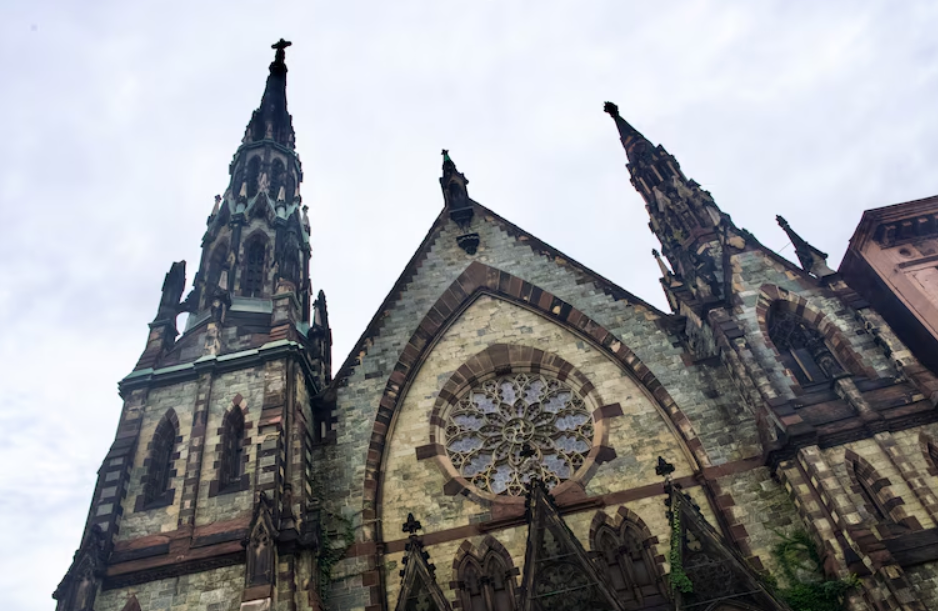
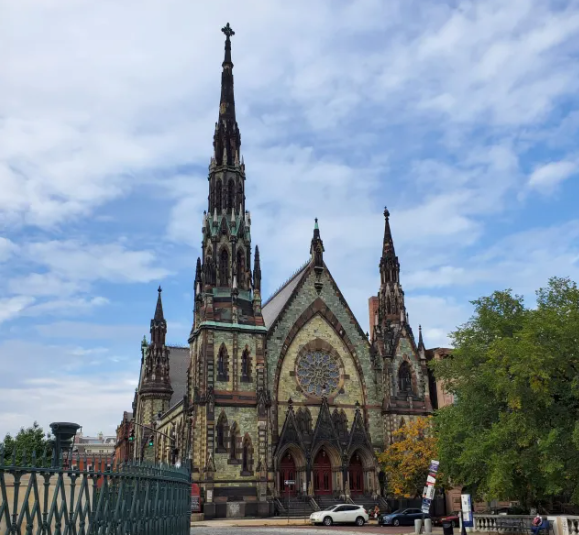
Constructed in 1872 on the grounds of the mansion of Charles Howard, the Mount Vernon United Methodist Church is a remarkable example of Gothic Revival architecture. Its soaring steeple, glowing rose window, stained glass, and heavy stone façade were inspired by late medieval churches like Notre Dame cathedral in Paris, built in the 12th century. Here in Baltimore, worshippers could be reminded of the deep roots and long tradition of their Christian faith.
The Mount Vernon Episcopal Methodist Church, as it was then known, was designed and built by the architects Thomas Dixon and Charles L. Carson. Over two decades, until Carson’s untimely death at age 44, this architectural firm built churches, synagogues, masonic temples, banks, company headquarters, and private houses. They were the architects of Baltimore’s Gilded Age, when the City’s merchant and professional leaders spared little expense to ornament their homes, places of business, and houses of worship.
![Mt V CHurch # 13[62].JPG](https://static.wixstatic.com/media/7af258_6a4a878f15504a2e92e9f68efb10c25d~mv2.jpg/v1/crop/x_0,y_123,w_3930,h_2632/fill/w_448,h_356,al_c,q_80,usm_0.66_1.00_0.01,enc_avif,quality_auto/Mt%20V%20CHurch%20%23%2013%5B62%5D_JPG.jpg)
The Cathedral of Methodism
The cost of Baltimore’s “cathedral of Methodism” was an opulent $400,000 in 1872. The price included land as well as the building and its furnishings. Six different types of stone lend the structure its extraordinary color. Now rare, the green serpentine meta basalt was quarried in Baltimore County. Buff and red sandstone trim were also sourced in regional quarries.
Major repairs and replacements of individual stone and carved pieces were undertaken in 1932 and in 1978. They are necessary once again.
A Star Spangled Legacy
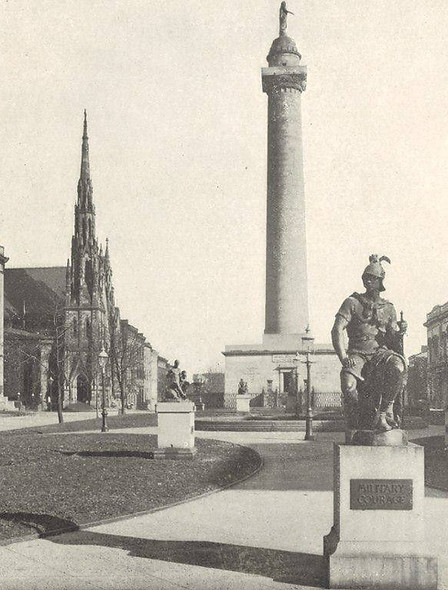
The Mount Vernon Place Church rises on the site of the mansion built by Charles Howard. A son of the Revolutionary War hero John Eager Howard, Charles married Elizabeth Phoebe Key in 1825. Four years later, they built the first house in what is now Mount Vernon Square. Elizabeth was the daughter of Francis Scott Key, famous as the author of The Star Spangled Banner. Key spent the last weeks of his life in the Howard mansion.
A commemorative plaque now adorns the stone façade of the church, marking the structure as a highlighted location on the National Historic Register.